The Merlies: a game about a world reclaimed by nature
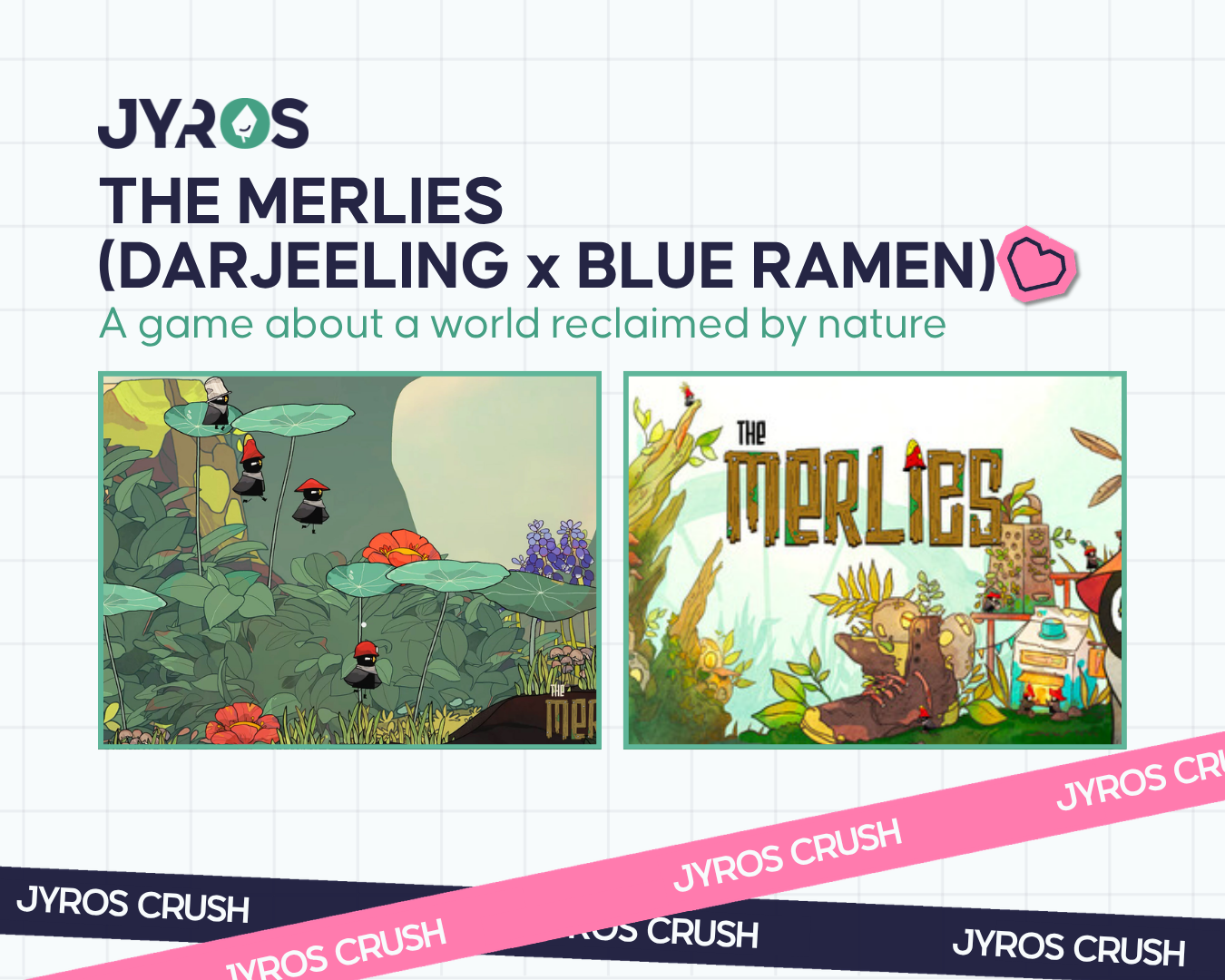
For this new JYROS Crush, we’re taking a closer look at The Merlies, a game developed by Darjeeling and co-produced with Blue Ramen that takes a fresh approach to telling stories about the environment.
Forget the bleak, desolate wastelands of post-apocalyptic fiction. In The Merlies, humanity is gone and nature has gradually reclaimed its place. A flock of clumsy little birds wanders through this world as it rebuilds itself, discovering the remains of our civilization and everything we left behind.
It’s a poetic, colorful and melancholic world that invites us to see our own in a new light.
A world after humanity
The Merlies started out in the sketchbooks of Cosmografik, whose drawings gradually grew into this world of little birds.
The game imagines a world where humans have disappeared but left traces everywhere. Shoes, balls, trash and other everyday objects become a mystery to these birds, who know nothing about the civilization that came before them.
The result is an unusual take on the end of the world. Rather than relying on the usual post-apocalyptic tropes, The Merlies offers a colorful, contemplative world, somewhere between the poetry of Miyazaki and the despair of The Last of Us.
But beneath its charm, the game has something very real to say about our relationship with the planet.
Raising awareness without preaching
For Marc Lustigman, co-founder of Darjeeling and creative producer, the goal was never to make a game that tells players what to think about the environment.
The team would rather leave room for interpretation. Above all, the game aims to “plant a seed”: to get players wondering about the way we consume, what we throw away and how we use natural resources.
It’s an approach you’ll find in other Darjeeling projects too, like Ordures, a stop-motion series whose star is a single-use plastic cup.
In The Merlies, it all comes down to a shift in perspective. Playing as little birds who stumble upon the remains of our civilization with no idea what any of it was for, players get to look at familiar objects with completely fresh eyes.
A shoe, a ball or a piece of trash suddenly becomes a new opportunity.
A new perspective, a new way of imagining
That may be what makes The Merlies stand out most: it deals with environmental issues without ever really addressing them head-on.
The game questions our place in a world whose resources we have long treated as endless. It hints at the need to consume more responsibly, but also at the possibility of different species learning to cooperate.
Taking this step back also gives players a break from the complexity of today’s climate debates. Seeing the world through the eyes of these little birds, they can simply take in the consequences of what we left behind.
It’s a way of talking about resilience and climate change through emotion, imagination and contemplation rather than lectures.
Sustainability starts with how games are made
The Merlies’ environmental approach goes beyond the game itself.
At Darjeeling, a studio of around thirty people with about fifteen on the project, the team has put several practices in place to reduce the environmental footprint of its production.
Most of the team commutes by bike or public transport. The studio also favors local servers and tries to keep its computers running for as long as possible.
Instead of leasing equipment and replacing it every few years, Darjeeling gets its hardware repaired and works with a local partner to collect and recycle anything that has reached the end of its life.
Remote work is part of the picture too. The collaboration with Blue Ramen, based on Reunion Island, was mostly handled remotely, which avoided regular flights between the two teams.
On their own, these choices may seem small, but together they reflect a real effort to think about the impact of the production process as a whole.
A responsibility that goes beyond studios
That said, for Loïc Manglou, game designer and co-producer of The Merlies at Blue Ramen, the green transition can’t rest on studios alone.
The games industry clearly has a role to play, not least because it reaches millions of people and can help them imagine the world differently. But environmental challenges go far beyond any single studio, or even any single industry.
That’s particularly clear on Reunion Island, where Blue Ramen faces the realities of island life: heavy reliance on imports, limited transport alternatives and no choice but to fly for some business trips.
It’s a reminder that the green transition also has to reflect the economic and geographic realities of each place.
For the teams behind The Merlies, it’s a shared responsibility: studios, major industry players, governments and institutions all have a part to play.
What if video games could help us see things differently?
Beyond its environmental message, The Merlies has a bigger ambition: showing that there are other ways to tell stories about the major challenges our society faces.
The teams hope the game will inspire a new generation of creators to explore more poetic, contemplative and dreamlike ways of telling stories.
That ambition means even more in an industry going through major upheaval, where young professionals are worried about their future and about where technology is heading, especially with the rise of AI.
Creating spaces where these questions can be discussed openly and without judgment is also part of what the teams are trying to do.
Out now
The Merlies is out since September 29, on Steam (PC and Mac) and Nintendo Switch, with PlayStation and Xbox versions possibly following later.
For Darjeeling and Blue Ramen, there’s obviously a lot riding on this release: finding an audience for the game is also what will allow the teams to keep making games with this kind of message.
Ultimately, The Merlies extends a simple invitation: to take the time to look at our world from a different point of view.
Through the eyes of little birds discovering, after we’re gone, everything we left behind.
And maybe it’s precisely by looking at things differently that we can start imagining how we want to build what comes next.