Eco-design and video game development: the challenges and solutions at Resonance Interactive
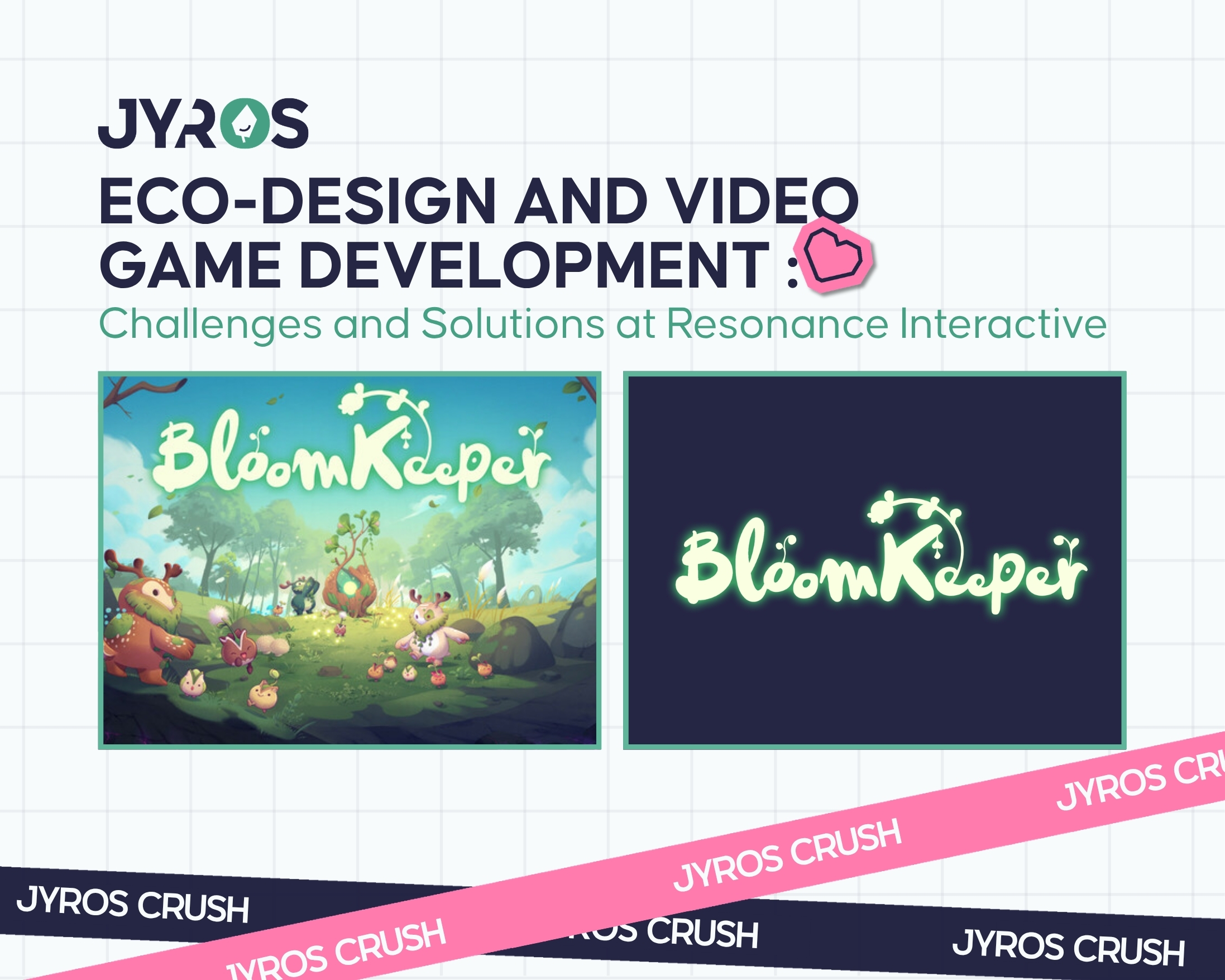
The video game industry is facing an increasingly pressing question: how can it reduce its environmental impact without hindering creativity and the economic viability of studios? Through an interview with Cédric Gazzano, lead developer at Resonance Interactive, and insights from Chloé Coudray of the JYROS team, we explore the practical realities of eco-design in an independent studio.
Striking a balance between environmental sustainability and the studio’s success
At Resonance Interactive, environmental awareness is part of the studio’s DNA. However, according to Cédric Gazzano, incorporating eco-friendly practices into game development is not always straightforward.
Eco-design initiatives may seem very ambitious at the start of a project, but they sometimes take a back seat to development constraints. For a young studio working on its first game, the challenges are numerous: time management, financial constraints, team organisation and the imperative to release the game.
In this context, the priority remains ensuring the studio’s success whilst trying to act on things that it has control over. With the upcoming release of their first game “Bloomkeeper” on September 16th , we asked them to share some insights into how they integrated environmental considerations into their development.
Technical optimisation as an environmental lever
Instead, rather than introducing a host of specific environmental measures, Resonance Interactive focuses above all on a fundamental principle of development: optimisation.
For Cédric Gazzano, optimisation offers several simultaneous benefits:
- enabling the game to run on less powerful machines
- reaching a wider audience thanks to improved compatibility
- enhancing gameplay fluidity and the player experience
- reducing energy consumption
The primary objective remains the quality of the game. However, this approach also benefits the environment.
Practical optimisation techniques
The studio implemented several technical optimisations during development.
Offloading certain calculations to the GPU
Some operations originally performed by the CPU have been offloaded to the graphics card. This more efficient distribution of the computational load improves overall performance.
Reducing the frequency of certain calculations
The studio also chose to underclock certain non-critical calculations. For example, the verification of ground conditions by trees in the game is not performed on every frame but at wider intervals.
As a result, this technique reduces the number of operations required without this being noticeable to the player.
Switching to an older graphics API
A surprising but effective choice was to switch from DirectX 12 to DirectX 11.
Initially, the team had chosen DirectX 12 to take advantage of the latest technologies. However, they found that their game ran better with DirectX 11, particularly because this version does not emphasise resource-intensive features such as ray tracing.
This change ultimately improved both performance and compatibility with a wider range of machines.
Note: DirectX is a set of components in Windows that allows software, primarily and in particular games, to work directly with your video and audio hardware.
Unity vs Unreal: two development philosophies
Cédric also touched upon the difference in philosophy between the two game engines.
Some engines, such as Unreal Engine, offer a very comprehensive set of advanced technologies by default. Whilst this approach makes certain projects easier, it can also lead to unnecessary resource consumption when these features are not being used.
Conversely, Unity takes a more minimalist approach: the project starts almost empty, and the developer adds only the necessary elements. This philosophy is better suited to Resonance Interactive’s approach, which prioritises precise control over the resources used.
Multiplayer: using players’ machines
Rather than renting dedicated servers, the studio decided to use players’ machines to host the games. This decision was initially driven by technical constraints, but it also offers an environmental benefit.
Indeed, this avoids reliance on data centres potentially located in regions where electricity generation is more carbon-intensive. The energy impact is thus spread across players’ individual machines.
The environmental impact of artificial intelligence
According to some estimates, a query to an AI model could consume several hundreds times more energy than a standard Google search. Although initially training the models accounted for the bulk of energy consumption, with the billions of daily queries, everyday use now has the largest environmental impact.
Cédric Gazzano primarily uses AI to save time by analyzing existing code for optimization opportunities and helping navigate extensive technical documentation. However, he deliberately limits its use, continuing to rely on official documentation and specialized forums for research and validation.
In some cases, AI has enabled him to discover optimisation solutions that he probably wouldn’t have found on his own.
A subtle environmental message in BloomKeeper
The studio’s game, BloomKeeper, also conveys an environmental awareness through its art direction and gameplay.
Rather than directly depicting environmental disasters or making players feel guilty, the game takes a more poetic approach. Tiny creatures called “the Pouics” gradually re-green the world.
The central idea is that real impact comes from collective action, and it is the many small creatures, guided by the player, that enable the environment to be transformed
A subtle environmental message in BloomKeeper
To build the game’s world, the team did not rely on specific scientific organisations. On the contrary, they deliberately distanced themselves from reality.
The aim was to create a world that wasn’t necessarily set on Earth, whilst remaining coherent. The developers drew inspiration from natural principles such as roots, trunks, leaves and plant growth to design an environment that was credible and harmonious with their imaginary creatures.
Using JYROS: a tool for measuring studios’ environmental impact
In order to track their impact, Resonance Interactive tells us that it has used the JYROS environmental impact calculator, as well as some of the free resources such as the eco-guide.
Officially launched in October 2023 following a pilot phase involving around thirty studios, JYROS is an environmental impact calculator created by and for studios. Its development was supported by public funding, notably from the CNC and the European Union. The tool enables studios to carry out an environmental assessment and gain a better understanding of the sources of their impact.
The tool also enables the generation of annual reports combining studio data with data from released games. This makes it possible to track changes in environmental impact from one year to the next.
A simple solution that enables studios to identify, in concrete terms, which emission categories to prioritise for action.
Anticipating changes in the sector
In the film industry, certain schemes are already in place to encourage productions to reduce their environmental impact, notably through incentives linked to eco-labels.
These initiatives could foreshadow future measures in the video game industry. The idea would be, in particular, to reward studios that are actively committed to this transition.
This type of incentive could encourage more players to adopt more responsible practices.
A gradual transition for the industry
Eco-design in video games is not limited to simple or immediate solutions. It often relies on a combination of technical, organisational and creative decisions.
The example of Resonance Interactive shows that technical optimisation, careful consideration of infrastructure and artistic choices can all help to reduce environmental impact, whilst remaining compatible with the economic realities of an independent studio.
Rather than perfect solutions, it is a process of continuous improvement, much like in BloomKeeper, where many small actions ultimately transform the landscape.
Bloomkeeper releases on steam on September 16, so don’t forget to wishlist it !